
Cover Crop vs Chem Fallow in No-Till Sorghum
Cover Crop vs Chem Fallow in No-Till Sorghum
Brent Bean, Sorghum Checkoff Director of Agronomy
In recent years, cover crops have gained favor across the U.S. as part of the sustainability and soil regeneration movement. Some of the potential benefits of cover crops are protecting the soil from wind and water erosion, increasing water infiltration, improving soil structure, and, in the long run, increasing soil organic matter and nutrient benefits and potentially sequestering carbon. Another common benefit that is often mentioned is weed suppression.
The last benefit of weed suppression was of particular interest to researchers at Kansas State University, who conducted a three-year study integrating a cover crop into the popular no-till, dryland wheat-sorghum-fallow system used in western Kansas and much of the southern High Plains. In this study, a cover crop of triticale+winter peas+canola+radish was planted following wheat harvest and compared to a standard chemical fallow system. Weed control, sorghum yield and net return were then compared.
Following wheat harvest, all treatments were sprayed with glyphosate and dicamba in late July. In the cover crop treatment, the cover crop was planted at the end of September or the beginning of October. Termination of the cover crop occurred in the middle of May, following triticale heading. At termination, a herbicide combination of glyphosate+acetochlor+atrazine was applied to the cover crop treatment, and at the same time to the chemical fallow treatment.
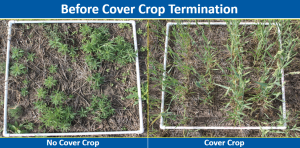
Across all three years of the study, adding the cover crop reduced weed density 34% to 81%. However, there was no significant difference in sorghum yields when averaged across the three years. The cover crop treatment averaged 23 bu/acre and the chemical fallow treatment 22 bu/acre. It is important to note that rainfall was considerably below the 30-year average in all three years of this study, which led to the low sorghum yields in both treatments.
Net return was much lower in the cover crop treatment, primarily because of the cost of the seed. On the positive side, the cover crop did significantly reduce weed density, which likely lowered the amount of weed seed that would have otherwise entered the soil bank. However, the cost of integrating the cover crop greatly exceeded the benefits of improved weed control, with lower net returns recorded in all three years compared to chemical fallow.