
Evaluating a Poor Sorghum Stand
Evaluating a Poor Sorghum Stand
Brent Bean, Sorghum Checkoff Director of Agronomy
Poor sorghum stands occur for several reasons, including dry surface soils, cool and wet planting conditions, hail, and even blowing soil. These conditions may result in plants emerging at different times, stands with fewer plants but relatively uniform, or with skips in the rows of various lengths. Fortunately, sorghum has a remarkable ability to compensate for stand reductions and uneven emergence.
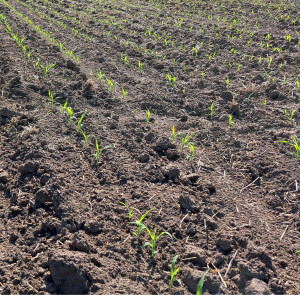
One concern is the emergence of plants at different times. Sorghum generally tolerates uneven emergence well. Field observations indicate that when plants emerge within 10 to 14 days of one another, yield losses are typically minimal. In reality, this is no different than a sorghum plant simply producing tillers. Although these plants or tillers may head slightly later, they often mature in time for normal harvest. In situations where the original stand has large skips in it but are filled much later, usually after a rain, yield loss will likely be minimal, assuming the later-emerged plants have time to mature. These later emerged plants will often, at least partially, make up some time by taking fewer days to reach maturity compared to the original stand.
A second concern is reduced but relatively uniform stand density. Sorghum is known for being relatively non-responsive to moderate changes in plant population across a wide range of environments. Yield reductions usually do not occur until stands are reduced by approximately 25 to 30 percent or more.
Research conducted at Kansas State University demonstrated sorghum’s strong ability to compensate for large skips. Remaining plants increased grain production through additional tillers, larger heads with more seeds, and, to a much lesser extent, heavier seeds. Studies comparing hybrids with different tillering capacities found little difference in their ability to maintain yield, as hybrids with fewer tillers compensated by increasing seed number per head.
The pattern of skips is often more important than the overall reduction in population. Large gaps or multiple skips in adjacent rows are more likely to reduce yields than isolated missing plants. Kansas State research showed that, when neighboring rows remained intact, it required a 9-foot skip within a 30-inch row to reduce yield by only about 5 percent. Similarly, a 36 percent uniform stand reduction reduced yield by less than 7 percent, while multiple 3-foot skips in adjacent rows reduced yield by approximately 11 percent.
Overall, sorghum’s ability to compensate for poor stands makes replanting unnecessary in many situations. Unless stand losses are severe or fields contain numerous large gaps in adjacent rows, maintaining the existing stand is often the best economic decision. As planting dates become later, the risks associated with replanting generally increase, further strengthening the case for keeping an established stand whenever possible.