Growing Sorghum During a Drought
Growing Sorghum During a Drought
Brent Bean, Sorghum Checkoff Director of Agronomy
Moisture conditions remain dry through most of the grain sorghum growing regions of the U.S., and if the three-month forecast can be believed, conditions are unlikely to improve much during the growing season. These circumstances are difficult for any crop, including sorghum. To make the most of this challenging situation, modification of agronomy practices may be necessary. This includes hybrid selection, planting date, seeding rate, fertilizer application and weed control.
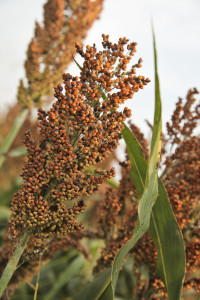
Choose a hybrid with a track record of good drought tolerance. This is not the year to experiment with an unproven hybrid. In most regions, there is an optimum planting date window when sorghum should be planted. However, under drought conditions, this window will likely need to be expanded. The first objective is to get a stand. Fields and equipment should be prepared well in advance so that planting can occur when a significant rain event occurs.
Seeding rates should also be adjusted. Under these conditions, consider lowering the seeding rate 20 percent. If conditions improve after planting, sorghum will compensate by adding tillers or producing more kernels per head. The exception to lowering the seeding rate would be if the planting date gets delayed too late into the season, requiring a quick-maturing hybrid to be planted. Under this scenario, tillering is reduced because of hot soil and air temperatures, thus requiring a higher seeding rate.
Unless fertilizer was purchased early, no one is going to be anxious to fertilize. Consider applying a little nitrogen (N) and phosphorus (P) as a starter and then delay the additional N until later in the growing season when the potential yield will be more evident.
Unfortunately, weed control is often more difficult in a drought. This is true for both PRE and POST herbicide applications. As is always the case with sorghum, it is best to control weeds before they emerge. For a pre-emergence herbicide to work, rain or mechanical incorporation is required. It generally takes 0.25 to 0.5 inches of rain to adequately move the most common sorghum herbicides sufficiently into the soil. Four herbicides, atrazine, s-metolachlor, acetochlor and dimethenamid are the most commonly used. Of these, dimethenamid (Outlook) requires the least amount of rainfall to activate. A common question is, “How long can a pre-emergence herbicide remain on the soil surface before it degrades to the point of no longer being effective?” Although it depends on a number of factors, the short answer is about two weeks. After a few days with no rain and none in the forecast, if possible, consider light tillage to incorporate at least some of the herbicide.
If a post-emergence herbicide is needed, use the highest labeled rate and high quality adjuvants, regardless of the herbicide. Always keep in mind that smaller weeds are much easier to control than larger ones and this is especially true under drought conditions.
Growing a successful crop during a prolonged drought is never easy, but using sound agronomy practices can at least give you a better chance at success.